Madhvacharya on Sadhaka-Gurus: ISKCON Scholars Publish a Compilation Approved by Three Madhva Scholars
Two ISKCON scholars have gathered what Śrī Madhvācārya taught about gurus who are not yet perfected, had the compilation approved by three Madhva scholars in Bengaluru, and asked them how their own tradition applies it. The 38-page paper is published here in full.
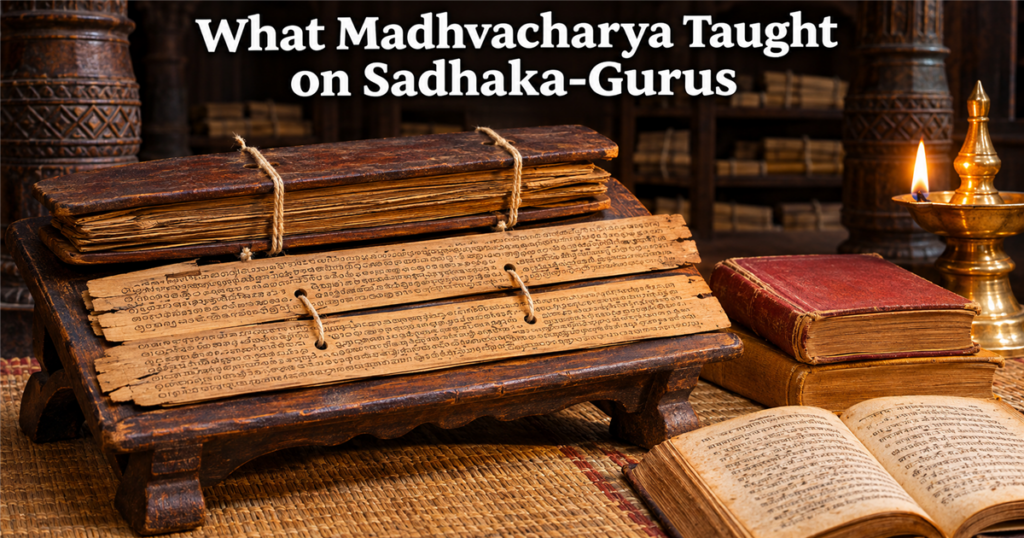
KARNATAKA, India — Vidvān Gaurāṅga dāsa and Rāma Aprameya dāsa have released “Śrī Madhvācārya on Sādhaka-gurus”, a 38-page compilation dated 7 November 2026 on what Madhvācārya and his commentators say about sādhaka-gurus, gurus “who are not on the perfectional stage of Bhagavad-bhakti”.[1] Its first part collects statements from Madhvācārya’s works with explanations from Tattvavādī sources; the second summarises interviews with three Madhva scholars, who, the authors write, “unanimously accepted” the first part as a correct account of Madhvācārya’s teachings. The authors say the research was taken up at the behest of Guru Prasād Swami. The paper was forwarded to Akincana Gocara for publication on 7 November, credited to Rāma Aprameya dāsa of Tumkur, Karnataka, with a cover note from the authors.[2] The full PDF is below.
It appears while ISKCON’s gurus prepare for the Governing Body Commission’s moratorium on all initiations, which runs from 1 December 2026 until Gaura Purnima 2027 and which the GBC justified in part by saying the Society had never undertaken a “sufficiently comprehensive study” of guru-tattva since Srila Prabhupada’s departure.[3] The paper itself does not mention the moratorium.
The authors’ introduction
“Though there have been several discussions in the writings of the Vaiṣṇava-sampradāyas about the cardinal importance of serving one’s gurus, it is in the writings of Śrī Madhvācārya that we come across discussions pertaining to sādhaka-gurus or gurus who are not on the perfectional stage of Bhagavad-bhakti.
We took up the task of assembling such statements into an article with explanations from Tattva-vādī sources, and submitted them same for the perusal of three English-speaking and recognized scholars from the Madhva line: (1) Acharya Veeranarayana Pandurangi, (2) P. Vinayacharya, and (3) Vyasanakere Prabhanjanacharya, all residing in Bengaluru. The article was unanimously accepted by them as correctly depicting the teachings of Madhvācārya on this topic.
We also interviewed these scholars in detail about Tattva-vādī practices — how do they actually apply this in their practical lives, and so on. The interviews were recorded and we composed an annotated summary of these interviews as another article.”
Vidvān Gaurāṅga dāsa and Rāma Aprameya dāsa, introduction, 7 November 2026
The authors add that they have begun a paraphrase of the first part for ISKCON devotees, with parallels from Gauḍīya Vaiṣṇava authorities, and have done preliminary research, not yet compiled, on related topics in Viśvanātha Cakravartī Ṭhākura, Jīva Gosvāmī, Bhaktivinoda Ṭhākura, the Viṣṇu-rahasya and the Rāmānuja-line Prapanna-pārijāta, among them how to deal with the improper teachings of a guru and the external symptoms of elevated devotees “which cannot be faked by others”.[1]
Part 1: Madhvācārya’s statements
The first part draws on Madhvācārya’s Brahma-sūtra-bhāṣya, Anuvyākhyāna with Jayatīrtha’s Nyāya-sudhā, Mahābhārata-tātparya-nirṇaya, Bhāgavata-tātparya, Tantra-sāra-saṅgraha and Upaniṣad commentaries, with glosses from Madhva scholars such as B. N. K. Sharma and K. T. Pandurangi. Its sixteen sections cover:[1]
- Two modes of gradation of candidates for spiritual development
- Gurus in the mode of gradation by birth
- Characteristics of gurus in that mode of gradation
- The significance of a guru in the śiṣya’s life
- The place and importance of a guru
- Satyakāma, Upakosala and their gurus
- Guru’s grace or personal effort — which is the more efficacious means
- Change of gurus — when permitted
- Why Satyakāma sought the approval of Gautama after learning from Gautama’s superiors
- Anuvyākhyāna on grades of gurus and śikṣā
- Tantra-sāra-saṅgraha on gurus
- An inferior as one’s guru
- What does “superior” mean in this context
- Who needs multiple gurus and who doesn’t
- Conditions for success in dīkṣā or śikṣā
- The meaning of “ācārya-devo bhava”
The section on an inferior guru quotes Mahābhārata-tātparya-nirṇaya 1.124 in this translation:[1]
“Sometimes, on account of special reasons, someone who is inferior may become a guru. They should also be honored with due respect, although not as much as to the one who is really superior. Pañcarātra mentions this, which is supported in the Purāṇas.”
Madhvācārya, Mahābhārata-tātparya-nirṇaya 1.124, as translated in the compilation
On changing gurus, the compilation sets out Brahma-sūtra-bhāṣya 3.3.46–47, which allows a disciple to accept a second guru who, of his own accord, bestows his full grace, and an appendix tabulates the cases: whether the second guru is superior, equal or inferior to the first, whether he came of his own accord, and whether the first guru’s permission is needed.[1]
Part 2: how the Madhvas apply it
The second part summarises recorded interviews, held in English on 11 and 13 June 2025, with Acharya Veeranarayana N. K. Pandurangi, professor and dean of Vedanta at Karnataka Samskrit University; Vidvān P. Vinayacharya; and Śrī Vyasanakere Prabhanjanacharya, with the authors’ annotations in footnotes.[1] Asked “What if the guru is unreliable?”, Pandurangi pointed to Madhvācārya’s own sannyāsa guru:
“Acyutaprekṣa was unreliable. Still, Madhvācārya accepted him as his guru and took sannyāsa from him even though the latter engaged in Advaitic dhyāna. Acyutaprekṣa had several arguments with Madhvācārya for a number of years, after which he submitted to Śrī Madhva. Now, why did Madhvācārya take sannyāsa-dīkṣā from him? He could have taken from Vyāsa Himself. (He could talk to Vyāsa.) Still, he took sannyāsa-dīkṣā from Acyutaprekṣa only.”
Acharya Veeranarayana Pandurangi, interviewed 11 June 2025, as summarised in the compilation
He also said that a change of guru “does take place” in the Tattvavādī community and is not considered an offence, giving his own case: from a family of Uttarādi Maṭha disciples, he studied at Pūrṇaprajña Vidyāpīṭha and accepted its founder, Śrī Viśveśvara Tīrtha, as his guru.[1] Prabhanjanacharya described how disciples rely on the institution to vouch for its gurus:
“When we get into a government bus, we don’t check if the driver has a driving license because these prerequisites are taken care of by the government. In an institutional setup, we expect the institution to take care of the prerequisites, but still we need the guidance of some trustworthy superior(s) to help us choose a proper guru.”
Śrī Vyasanakere Prabhanjanacharya, interviewed 13 June 2025, as summarised in the compilation
The interviews also cover mantra-dīkṣā and tapta-mudrā, sannyāsa and pīṭha-dīkṣā, how Madhva students are taught today, and naiṣṭhika-brahmacārīs and young sannyāsīs.[1]
The full paper
Note on the source: the compilation was sent to Akincana Gocara by one of its authors for publication. Akincana Gocara has not checked its Sanskrit texts or translations, and the interview passages are the authors’ summaries, not transcripts; the scholars’ approval of the first part is reported as the authors state it.
Read Also:
Sources
- Vidvān Gaurāṅga dāsa and Rāma Aprameya dāsa, “Śrī Madhvācārya on Sādhaka-gurus: A compilation” (PDF, 38 pages), 7 November 2026. Published above.
- Cover note from the authors and covering message, forwarded to Akincana Gocara with the paper on 7 November 2026.
- “GBC Orders Every ISKCON Guru to Stop Initiating Until Gaura Purnima 2027”, Akincana Gocara, 26 October 2026. akincana.net/2026/10/26/gbc-orders-every-iskcon-guru-to-stop…
Discover more from Akincana Gocara
Subscribe to get the latest posts sent to your email.