Documentary: Leather-Free Madhura Mridangas Have Spared 5,000 Cows and Calves Since 2019
An eight-minute film by the Indian documentary channel Stories That Matter tells how a boat crossing at Mayapur in 2011 led an ISKCON devotee to develop a khol with no leather in it. Its maker says about 5,000 have gone out since 2019.
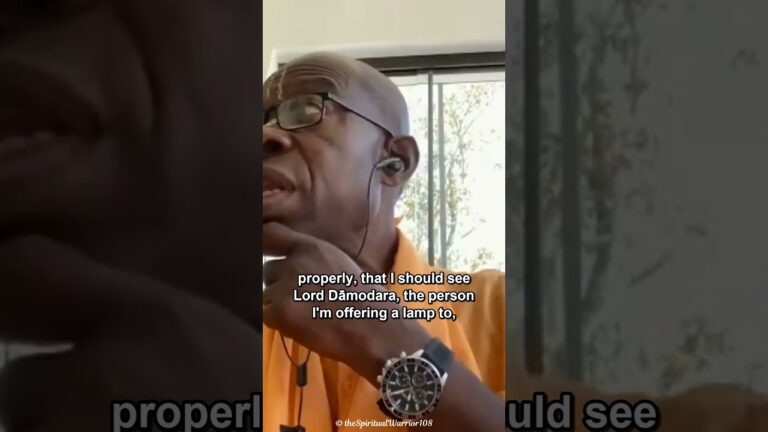
INDIA — The documentary channel Stories That Matter released a film on 24 October titled “Why This Sacred Drum Costs 5,000 Lives?”, profiling the Madhura Mridanga, a khol built without cow leather by the Centre for Traditional Education (CTE) and the Bengaluru musician and engineer Dr. K. Varadarangan.[1] In the film, CTE’s founder Bharat Chandra Dasa says the project has distributed around 5,000 drums since 2019, which by his count means roughly 2,500 cows and 2,500 calves that were not slaughtered for drumheads.[1] The project’s own website says it was taken up on the instruction of Bhakti Raghava Swami.[2]
A boat crossing at Mayapur
The film traces the project to an incident Bharat Chandra Dasa witnessed years earlier in Mayapur.[1]
“I was going from Mayapur to other places. We had to go through the boat. On a similar trip, cows were also onboarded on the boat, and they were looking very panicked. I could make out it’s not normal. So I asked naturally some people what is the reason the cows are being taken like this, and the person happened to say that they are taken for slaughter. In the land of worship, in the land of pilgrims, this is happening in front of our eyes. And that’s where I started really thinking.”
Bharat Chandra Dasa, in “Why This Sacred Drum Costs 5,000 Lives?”, Stories That Matter, 24 October 2026[1]
He wrote up the experience on 19 May 2011 in an article titled “Our Sankirtana Tainted with Blood of Slaughter”, which the Madhura Mridanga website reproduces. In it he describes the ferry between Navadvipa and Mayapur, says his enquiries with drum makers confirmed that the trade is “a huge export business”, and argues that the leather for khols comes almost entirely from slaughtered cows: the large head from calf skin and the small head from the neck of a cow.[2]
The same article records an earlier attempt at a solution. Two students from Mayapur, Bhakta Sujal and Bhakta Laxmipati, who had attended the Varnasrama College course at Sahyadri Krishna Balaram Ksetra, started an “Ahimsa Mrdanga” project using the hides of cows that had died naturally. Bharat Chandra Dasa wrote that such units could be set up wherever ISKCON has a goshala.[2]
The instruction
The website’s account says that after the 2011 article circulated, the team was “remorseful that no solution has been struck”, and that Bhakti Raghava Swami “instructed us to come out with a solution for cow protection” in the matter of mridangas. A photograph on the page shows the finished drum being offered to Bhakti Raghava Swami, which the caption dates to around 2019.[2]
The page grounds the effort in Srila Prabhupada’s own instructions as the makers read them: that leather for mridangas may be used, “but NOT by killing cows, but from naturally dead cows”, and that if such leather is unavailable, “alternatives such as plastic, etc., could be used”. It also recalls Srila Prabhupada’s assignment to his disciple Ishana Dasa to develop a mridanga with American technology, a project the page says he was still asking about from his bed in 1977.[2] Akincana has not checked these quotations against the Bhaktivedanta archives.
The numbers
The film states that about 10,000 mridangas are needed worldwide every year, that a leather khol lasts no more than two years, and that a professional instrument sells for around ₹15,000 on average, which has turned instrument making into “a massive commercial industry” supplied by commercial slaughter rather than by cows that died naturally.[1] Bharat Chandra Dasa sets out the arithmetic behind the title:
“For two mridangas, one cow and one calf leather has to be used. That means they are directly causing the killing of the cows and calves. So, in other words, since 2019, approximately we have distributed around 5,000 mridangas, which means roughly about 2,500 cows and 2,500 calves we were able to directly save and protect. I’m happy, and I hope it continues the same way.”
Bharat Chandra Dasa, in “Why This Sacred Drum Costs 5,000 Lives?”, Stories That Matter, 24 October 2026[1]
The makers’ own website gives wider ranges: 6,000 to 10,000 leather khols sold a year in one passage and 8,000 to 10,000 in another, and 3,000 to 5,000 cows killed in one place against 10,000 to 30,000 cows and calves in another, the larger figure covering all types of mridanga. The figures are the project’s estimates and are not sourced to any trade or government statistic.[2]
From the SRI mridangam to the Madhura Mridanga
The website says a chance email exchange with Diana Ratnagar, chairperson of the animal-welfare group Beauty Without Cruelty, led the team to Dr. Varadarangan, a Carnatic vocalist and scientist who had already built a leather-free mridangam he calls the SRI mridangam.[2] A March 2024 feature in Shaastra, the IIT Madras magazine, identifies K. Varadarangan as an IIT Madras alumnus and founder of the Bengaluru company Karunya Musicals, which makes mridangams and tablas with synthetic drumheads.[3]
In the film, Bharat Chandra Dasa says the team then spent about a year and a half of trials adapting the design to the khol used in Bengali-style kirtan before launching it as the Madhura Mridanga.[1] The narration describes the drum as bio-safe and “made from plastics used in medical implants”; the website lists heads of polypropylene and polyester film, a three-year warranty and a claimed half-life of twenty years.[1][2] Its selling points in the film are practical as much as ethical: no change of pitch with the weather, a sound the makers say matches the original, and a shell that “even if thrown, never breaks”.[1]
The project is run under the CTE, a non-profit registered trust that lists Bharat Chandra Dasa (Harsha B. Wari) as its founder and president and Mahendra B. Wari, who is thanked in the film credits, as a supporting team member responsible for publications.[4] The drums are sold by Tamaltree Enterprises Pvt. Ltd.[2] The website carries endorsements from kirtan leaders including Vaisesika Dasa, who is quoted calling it “the best Mridanga in the market today”.[2]
Read Also:
Sources
- Stories That Matter (Raga Productions), “Why This Sacred Drum Costs 5,000 Lives?”, YouTube, 24 October 2026, 8 min 44 s. youtube.com/watch?v=OnZNtRLLXCk
- “About”, Madhura Mridanga (Tamaltree Enterprises / Centre for Traditional Education), undated, including Bharat Chandra Dasa, “Our Sankirtana Tainted with Blood of Slaughter”, 19 May 2011. madhuramridanga.com/about/ (archived copies)
- Sweta Akundi, “The new sound of music”, Shaastra (IIT Madras), vol. 3, no. 2, March 2024. shaastramag.iitm.ac.in/lead-story/new-sound-music
- “About us”, Centre for Traditional Education, undated. cteindia.org/about-us/ (archived copies)
Discover more from Akincana Gocara
Subscribe to get the latest posts sent to your email.