“We Were Cut Off”: IISB Scholars Say GBC Gave ISKCON India Half an Hour on Female Diksa Gurus
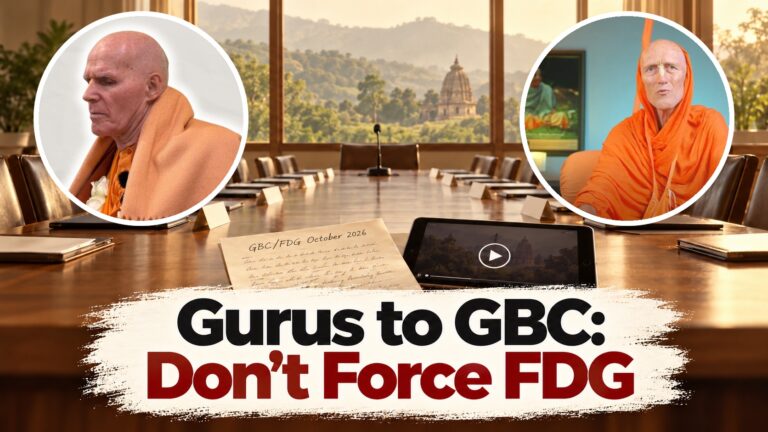
Hours after ISKCON India’s delegation spoke at the GBC’s mid-term meeting on Vaishnavi diksa-gurus, three ISKCON India Scholars Board members recorded a 73-minute debrief. They say the delegation had half an hour, that a resolution of India’s leaders was read without a response from the floor, and that their presentations on errors in the GBC’s own research were never heard.
WADA, India — The ISKCON India Scholars Board (IISB) says the Governing Body Commission (GBC) gave ISKCON India’s delegation only about thirty minutes on 20 October to present its case against female diksa-gurus, and then asked it to leave before its scholars could speak. In a video published on 21 October, IISB convener Krishna-kirti Das and scholars Damodara Das and Sridhara Srinivasa Das call the time limit “unjust” and set out the arguments they say they were not allowed to make.[1] GBC Chairman Madhusevita Dasa described the same day as “an intense discussion” and said the commissioners were “very much concerned about finding solutions to the issue”.[2]
The meeting
The GBC opened its 2026 Midterm General Meeting (MGM) at Govardhan Eco Village in Maharashtra on 19 October.[4] The second day was dedicated to Vaishnavi diksa-gurus (VDG), women initiating spiritual masters, and the discussion continued on the third day, with the agenda widened to the position and function of the guru in ISKCON. No decision has been reported.[2][3]
The IISB video opens with Madhusevita Dasa’s update on the second day and then comments on it.[1] The IISB is the scholarly body of the ISKCON India Bureau; one of the scholars says in the video that it was created in 2013 specifically to respond to the female diksa-guru issue.[1]
“We were cut off”
According to the three scholars, the session went like this:[1]
- ISKCON India’s leaders read out a resolution of the India Continental Committee (ICC), the largest body of ISKCON leaders in India, rejecting female diksa-gurus. The speakers describe the vote as nearly unanimous, with about 200 members of some 202 against. The reading took about 25 minutes.
- There was, they say, “almost no response from the GBC”: no discussion from the floor.
- In the five minutes left, a former member of the GBC’s Sastric Advisory Council (SAC), described as a charter member, gave his own eyewitness account of what the scholars call irregularities in the SAC’s methods.
- A senior Bureau member made a few more comments, and the delegation was then asked to leave.
“Before coming into the meeting, we knew we will not be able to fit in all that we have to say in 30 minutes. This was very clearly communicated to the GBC. And we clearly said that how much time we need. Because this is an issue that has been going on for 26 years. As you said, there are two parties. And they’re ready to hear one party, the pro side, longer than they’re giving only 30 minutes to the other side. It was unjust. It was unfair.”
IISB panelist, “Inside the FDG Conflict: GBC MGM”, 21 October 2026[1]
Later in the video, one panelist recounts objecting during the meeting that the time was too short and says Madhusevita Dasa answered, “life is too short.” He contrasts that with the hours the GBC then spent among itself on the topic: “You didn’t have 10 minutes for me, but you have another 8 hours to discuss, and you discovered that we have problem with guru-tattva.”[1] Akincana has not been able to hear the GBC’s side of that exchange.
The presentations that were not given
The scholars use the video to make the points they had prepared. Both concern the SAC’s 2005 paper on female diksa-gurus, which they say the GBC relied on when it approved Vaishnavi diksa-gurus in 2019.[1][6]
Dhruva, Suniti and the “Vedic initiation” argument
In his purport to Srimad-Bhagavatam 4.12.32, Srila Prabhupada writes that Suniti, being a woman and Dhruva Maharaja’s mother, could not become his diksa-guru.[5] According to Krishna-kirti Das, the SAC set this statement aside as not relevant today, arguing among other things that the pastime took place in Satya-yuga, under a Vedic system in which women did not receive initiation and therefore could not give it. He calls this “a major fault”: citing Vamsidhara’s commentary on Bhagavatam 4.8.54, he argues that Dhruva, at five years old, was too young for upanayana, the Vedic initiation, and therefore received a Pancaratrika mantra, “om namo bhagavate vasudevaya”, from Narada Muni. If Dhruva’s own initiation was Pancaratrika, he argues, the SAC’s distinction does not hold.[1]
A verse from the Bharadvaja Samhita
The second point concerns the Bharadvaja Samhita, a Pancaratra text. One of the scholars says that verses 1.14–15 allow women and children to receive mantras, but verses 1.42–43 state that a woman never gives a mantra (“na jatu mantra-da nari”). The SAC paper, he says, holds that in the Pancaratra system women could both receive and give mantras, and treats Pancaratra as “more recent” than the Vedas, which he disputes, citing Madhvacarya and Srila Prabhupada’s purport that the Pancaratras were spoken by the Lord himself. He says he found the verse in 2017 in a copy of the text uploaded online by a member of the SAC, and adds that “it was a matter of 15 minutes for me to download it.”[1]
“Shastra when it supports us”
Krishna-kirti Das describes what he calls an arc in the debate: the SAC used scriptures beyond Srila Prabhupada’s books in 2005, but once the IISB’s research on the Bharadvaja Samhita appeared, and later commentary by Baladeva Vidyabhusana that the scholars say supports their reading, the GBC side moved to restrict the evidence to Srila Prabhupada’s own words.[1]
He says this is why the India Bureau withdrew from the Global Vaishnavi Diksa Guru (GVDG) committee formed in July this year. According to him, the committee’s terms of reference allowed only Srila Prabhupada’s books, letters and teachings, and he and Basu Ghosh Das, who represented the Bureau, objected that the SAC had been allowed to go further and that Srila Prabhupada himself told readers to study the previous acaryas.[1]
“So, I just want to close it up here is that, you know, we see it kind of like an arc that okay, as long as the shastra was proving our point, we’re going to admit shastra and now that it’s not proving our point, it’s not proving shastra.”
Krishna-kirti Das, IISB convener, 21 October 2026[1]
He also calls the GBC “basically a black box authority”, pointing to the three-year moratorium on female diksa-gurus, during which, he says, guru-tattva was to be discussed with the India Bureau: “3 years of discussions, and where are the receipts? … Where’s the recording the dialogue? Where’s the minutes?”[1]
Reading the Chairman’s update
The scholars question what Madhusevita Dasa meant by an “intense discussion”. One of them says he understands that only two or three GBC members oppose female diksa-gurus, and suggests that the intensity reflects threats that ISKCON India, or North America, might split, rather than a disagreement over whether the change is right. If so, he says, “that’s a political concern”.[1]
Krishna-kirti Das calls the turn to guru-tattva “grasping at straws”, and argues the opposite order to the one the GBC has chosen: the question of female diksa-gurus is, in his view, a special case of a general one, the eligibility of non-liberated persons to act as guru, and settling it would inform the wider question. He adds that the IISB has “absolutely no objection” to women of the topmost spiritual level giving initiation. He also compares the two camps’ use of evidence: just as ritviks build on Srila Prabhupada’s 9 July 1977 letter, he says, supporters of female diksa-gurus build on his 3 January 1970 letter to Hansadutta, while setting aside his Bhagavatam purport about Suniti.[1]
The other side
The video presents only the IISB’s view. The GBC approved Vaishnavi diksa-gurus under set conditions in 2019, with the SAC’s research as part of its basis.[6] Madhusevita Dasa’s public update speaks of the GBC seeking “solutions” and moving its agenda “to give room to both the Vaishnavi diksha guru issue and even more important the issue of the guru in ISKCON”.[2] As of the evening of 21 October, neither the GBC nor the SAC had answered the scholars’ account of the session or their criticisms of the 2005 paper in any public statement Akincana could find. Akincana will publish a response if one is offered.
Where things stand
The MGM’s discussion of Vaishnavi diksa-gurus and of the guru in ISKCON was due to continue on its fourth day.[3] The IISB says it plans more such discussions.[1]
A note on the source
The video is an advocacy discussion by scholars of one side of the dispute; its account of the GBC session is theirs. Akincana has not seen the ICC resolution or the minutes of the session and has not independently confirmed the vote count, the time allotted or the exchange with the Chairman. Quotations are taken from YouTube’s automatic captions and checked for sense; the captions garble several names, and where a speaker could not be identified with confidence he is described as a panelist. Readers should check quotations against the video.
Read Also:
Sources
- ISKCON India Scholars Board, “Inside the FDG Conflict: GBC MGM”, YouTube, 21 October 2026 (1 h 13 min). youtube.com/watch?v=XkMxWeWixms
- ISKCON Governing Body Commission – GBC, “GBC MGM 2026 | Day 2 Highlights – Vaishnavi Diksha Guru Discussion”, YouTube, 20 October 2026. youtube.com/watch?v=ufbPqKfLQrI
- ISKCON News Staff, “GBC MGM Continues Guru and Vaishnavi Diksha Guru Discussions”, ISKCON News, 21 October 2026. iskconnews.org/gbc-mgm-continues-guru-and-vaishnavi-diksha-gur…
- ISKCON News Staff, “GBC Midterm Meeting Explores ISKCON Affiliation Framework”, ISKCON News, 19 October 2026. iskconnews.org/gbc-midterm-meeting-explores-iskcon-affiliation…
- A.C. Bhaktivedanta Swami Prabhupada, Srimad-Bhagavatam 4.12.32, purport. vedabase.io/en/library/sb/4/12/32/
- “Resolution of the ISKCON Governing Body Commission (GBC) Regarding Vaishnavi Diksa-gurus”, Akincana Gocara, 18 October 2019. akincana.net/2019/10/18/resolution-of-the-iskcon-governing-bod…
Discover more from Akincana Gocara
Subscribe to get the latest posts sent to your email.